
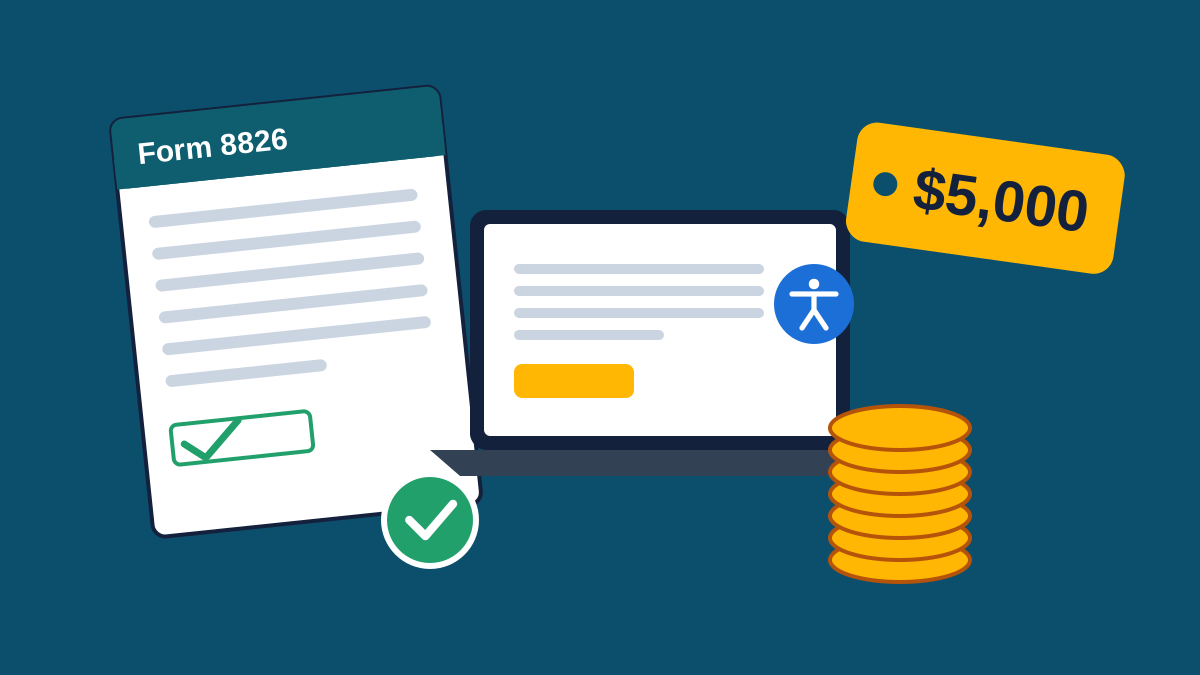
IRS Tax Credit of Up to $5,000 Toward Website Accessibility Costs
A quick note before we start: Accessible Adirondack Tourism is a nonprofit, not an accounting or law firm, and nothing here is tax or legal advice. Please run your own situation past your tax professional before you claim anything.
A Tax Credit That Can Help Pay for an Accessible Website
If you run a small business, there’s a federal tax credit that can cover half of what you spend making your business more accessible, up to $5,000 a year. It’s called the Disabled Access Credit, and a lot of business owners have never heard of it.
The credit has been around since 1990, the same year the ADA became law, and it’s still available today. Since so much of your business now happens on your website, it’s worth knowing about.
How the Disabled Access Credit Works
The credit comes from Section 44 of the Internal Revenue Code. It’s worth 50 percent of your eligible access expenditures for the year that are more than $250 and up to $10,250. That’s where the $5,000 maximum comes from: $10,250 minus $250 is $10,000, and half of that is $5,000.
It’s a credit, not a deduction, so it comes straight off the tax you owe instead of just lowering your taxable income. It isn’t refundable, which means it can bring your tax bill down but won’t create a refund on its own. If you can’t use all of it in one year, it rolls into the general business credit, which has its own carryback and carryforward rules your tax pro can walk you through.
Who qualifies
You’re an eligible small business if, in the previous tax year, you either had gross receipts of $1 million or less, or had no more than 30 full-time employees. You only need to meet one of those two tests.
What kinds of costs count
Eligible expenses are the reasonable and necessary costs of making your business accessible to people with disabilities so you can comply with the ADA. The tax code specifically mentions effective ways of making visual materials available to people with vision impairments and audio materials available to people with hearing impairments. Many tax advisors see accessibility work on a business website as fitting that description, which is why this credit comes up so often in website conversations. The IRS doesn’t list websites by name, though, so this is exactly where your tax pro’s opinion matters.
A Simple Example
Say your new website costs $6,000, and $3,000 of that is accessibility work, like an accessibility audit, fixing color contrast and headings, adding proper form labels and captioning your videos.
- Start with your accessibility spending: $3,000.
- Subtract the first $250: $3,000 minus $250 is $2,750.
- Take half of that: 50 percent of $2,750 is $1,375.
- Your credit is $1,375.
If your accessibility costs for the year were $10,250 or more, you’d hit the $5,000 cap.
You can claim it more than once
The credit is available every year you have eligible expenses. So ongoing work, like testing your site after updates or making new content accessible, may qualify in later years too. One catch: no double dipping. Whatever amount you take as a credit can’t also be deducted as a business expense.
How to claim it
You file IRS Form 8826 with your tax return. Keep good records. When you’re planning a new site or a round of fixes, ask your developer to list the accessibility work as its own line on the invoice. It makes your accountant’s job a lot easier.
If you have a physical location too
There’s a separate tax deduction of up to $15,000 a year for removing architectural barriers, like adding a ramp or widening a doorway. That one is for physical changes, not websites, but a business can use both in the same year.
Accessible Adirondack Tourism does not build websites. If your website needs to be built or updated to meet ADA/WCAG standards, our partners at Adirondack Website Design, experts in ADA/WCAG website development, can help. If you have questions about website accessibility in general, get in touch with us.
Sources and Further Reading
- About Form 8826, Disabled Access Credit, Internal Revenue Service
- Tax Benefits for Businesses Who Have Employees with Disabilities, Internal Revenue Service
- Tax benefits of making a business accessible to workers and customers with disabilities, IRS Tax Tip 2021-183
- 26 U.S. Code Section 44, Expenditures to provide access to disabled individuals, Legal Information Institute, Cornell Law School